
Fields in Middlesex County Property Tax Records
Connecticut abolished county government. Middlesex County has no assessor or tax collector of its own. Each of its fifteen municipalities builds an October 1 Grand List and handles billing locally. So a property tax search always joins two municipal records. The assessor's property card supplies the valuation side. The tax collector's account shows the billed obligation and payment status. On the card, land, improvements, total appraisal, and total assessment usually appear as separate figures. The collector's account tells you what is actually owed.
| Field | What It Shows | Where |
|---|---|---|
| Appraised value | Municipal estimate of full property value for the stated year | Town assessor card |
| Assessed value | Taxable value, generally 70 percent of appraisal under Connecticut practice | Town assessor card |
| Land and improvements | Separate value components behind the total | Town assessor card |
| Exemptions | Relief or adjustments applied to the taxable assessment | Assessor and municipal forms |
| Bill and balance | Current charge, installments, payments, interest, or delinquency | Town tax collector |
A seventy percent assessment is not a sale price. It is not a private appraisal either, and it is not a title opinion. A deed's consideration is a different historical fact altogether. The tax amount also depends on the mill rate in force plus any district charges. When you compare records across towns or across years, carry the valuation date with each number. That keeps the comparison honest.
Assessor, Collector, and Clerk Roles
Three offices split the work. The assessor builds the Grand List identity and value. The tax collector applies the bill and takes payment. The town clerk records deeds, mortgages, releases, and tax liens. Middletown offers separate Assessor and Tax Collector routes. Clinton and Cromwell keep their own municipal records. Keep the roles distinct. A paid bill does not establish ownership. An assessor's owner of record does not prove every lien has been released.
Not sure which town holds the parcel? Test the situs in its GIS map first. Postal names like Rockfall, Ivoryton, and Higganum are delivery clues, not land-record jurisdictions. The correct town controls both the assessment and the bill search. Pinning it down first saves you from querying the wrong collector entirely.
Note: Use the property's physical location, not only the owner's mailing address, to choose the municipal office.
Municipal Assessment Search Fields
Vision-hosted assessor pages, which several local municipalities use, can expose a few different search keys. Exact labels vary from town to town. There is no countywide parcel-number format, so expect each assessor's system to define its own keys.
| Search key | How to use it | Important distinction |
|---|---|---|
| Location | Enter the situs street or browse a street listing | Not the tax-mailing address |
| Owner | Try the roll name and spelling variants | May reflect the Grand List date |
| PID, Acct#, Mblu, Map-Lot | Copy the town's exact identifier | Preserve leading zeros and cut or unit notation |
| Sales search | Filter transfers where the local page offers it | Sale consideration is not assessed value |
A result card can show plenty: owner and co-owner, mailing address, situs, land and building details, appraisal and assessment histories, sale date and price, and deed book and page. Not every town publishes every field, though. Treat the card as a starting point and confirm gaps with the assessor.
Middletown Tax Accounts and Delinquency
For current bills, prior payments, delinquent balances, and clearance questions, the Middletown Tax Collector is the authoritative source. Delinquent Middletown obligations carry interest at 1.5 percent per month as a general reference, but account-specific math must come from the collector. Match any search result to the parcel and bill year before you pay anything.
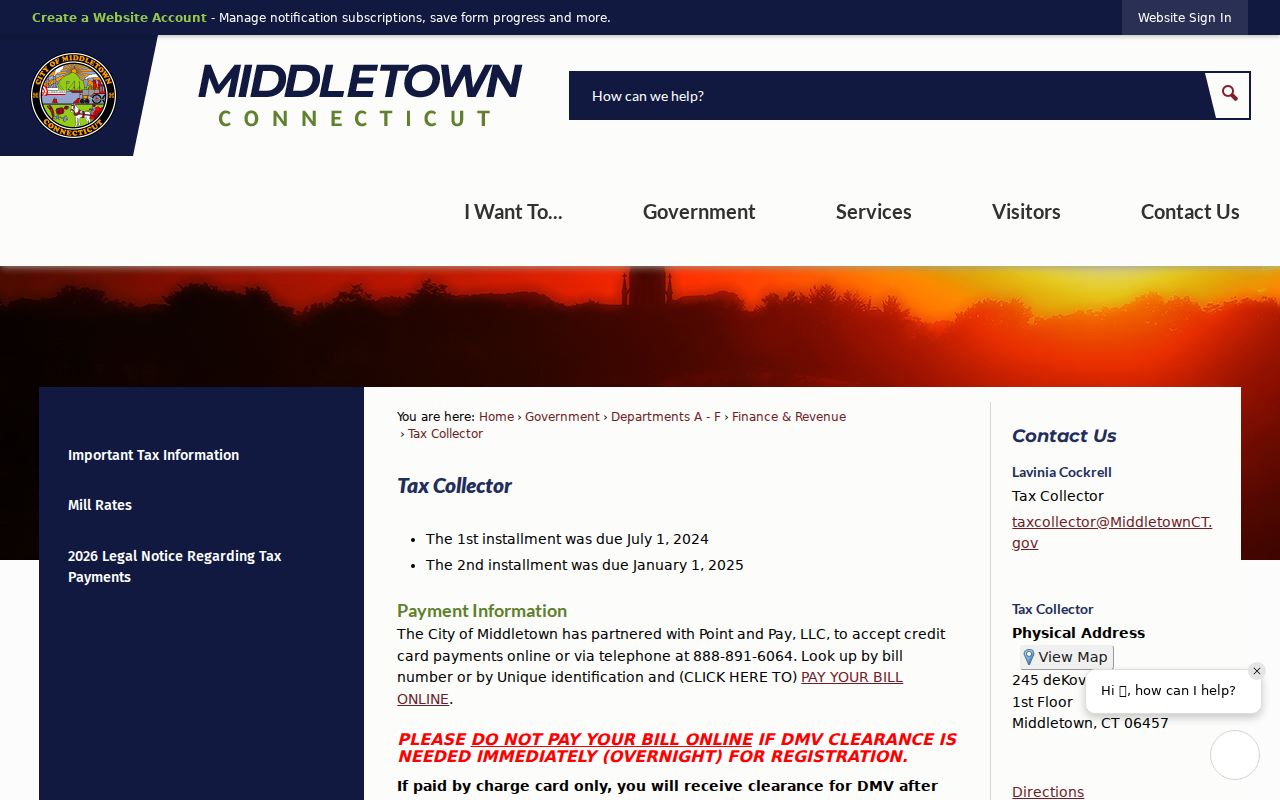
Tax billing in Middletown is a town service. It is not a countywide account system. The collector's official page states as much.
That same official page is the fallback. Use it when an online account omits a prior year or a recent payment. When you call, have the property address, account or bill number, list year, and a stated payoff date ready. A tax lien in the town clerk's land records is related. It is not the same screen as the collector's balance, so check both if the question is whether anything is still owed.
Revaluation Clocks Differ by Town
Dates belong beside every Middlesex County tax value, and recent revaluation work shows why. Clinton's assessor notice says its completed revaluation takes effect October 1, 2025. The prior assessment date was October 1, 2020. It also warns against applying the old mill rate before the spring 2026 rate-setting process. Middletown's 2026 appraisal RFP sketches a proposed 2027 assessment effort covering CAMA, property cards, parcel maps, land-value maps, and sales data. That procurement does not mean a new roll is finished.
Cromwell runs on its own revaluation timeline, separate from Clinton and Middletown. For countywide comparisons, use equivalent valuation dates. Do not place current cards side by side without adjustment.
Taxable Value Is Not Sale Price
Connecticut's assessment ratio can make two figures look mathematically linked when they answer different questions. Appraisal is the assessor's valuation for a revaluation cycle. Assessment is the taxable portion carried to the Grand List. A sale price comes from a transaction and may show up on the assessor card or the recorded conveyance. The final tax bill applies a municipal mill rate to taxable value. Local district treatment may apply on top. Keeping those four figures straight prevents most confusion in a property search.
- Grand List
- The municipality's October 1 assessment roll.
- Mill rate
- The rate applied per thousand dollars of taxable assessment.
- Exemption
- A statutory or local adjustment administered under eligibility rules.
- Tax lien
- A recorded claim connected with unpaid taxes, checked through land records.
Keep the clocks separate. Assessment date, recording date, billing date, and payment date may all differ on the same property.
Look Up a Middlesex County Tax Bill
Start at the municipality's assessor record. Then move to that same town's tax collector. This keeps a postal place from sending you to the wrong collector, and it gives you the account key needed to match the bill to the parcel.
- Identify the municipality through its assessor or GIS and search by situs address.
- Copy the exact PID, Acct#, Mblu, or Map-Lot shown on the card.
- Open that town's collector service and match the address, owner, account, and list year.
- Read installments and payment status, then contact the collector for a dated payoff or missing transaction.
- Check the assessor card for exemptions and the town clerk index for any recorded tax lien or release.
- Assessed value
- The taxable portion of the municipal appraisal.
- Mill rate
- The locally adopted rate used to calculate the levy.
- Exemption
- Relief applied only after the assessor confirms eligibility.
- Tax lien
- A claim for unpaid taxes that may appear in recorded land records.
Exemptions and Protected CAMA Fields
Exemptions belong to the municipal assessor, never a county office. Use the town's current form and deadline, supply the requested proof, and confirm how the adjustment lands on the Grand List. Published CAMA data can also suppress protected fields. Connecticut OPM describes a suppression field required for protected data under CGS §1-217, so a missing public field does not mean the assessor lacks an internal record. When a value or exemption looks unexplained, ask the assessor for the card and the applicable public portion. Connecticut FOIA, CGS §§1-200 through 1-242, supplies the inspection and copy framework, subject to exemptions and specialized tax rules.
Property Tax Liens and Court Records
A delinquent tax bill leaves a wider trail than the collector screen. Tax liens, releases, lis pendens, and foreclosure instruments land in the town clerk's land index for the town where the parcel sits. Litigated disputes show up elsewhere. The Connecticut Judicial Branch civil inquiry can surface a docket number, though its web result is not the official court file. Older or restricted material may require the Middlesex Judicial District clerk.
Middlesex County publishes no countywide tax-sale calendar. A delinquent label does not prove a sale. Confirm status and deadlines with the collector, the clerk, or the court as applicable.
Appeal a Middlesex County Assessment Locally
Assessment appeals in Middlesex County go to each municipality's Board of Assessment Appeals, so review the town's notice and form for the relevant Grand List. Dates and procedures are local. Evidence lands hardest when tied to the valuation date: the property card, photographs, measurements, comparable sales, permits, and a clear explanation of any factual error. Cromwell's published route sets a February 20 filing rule. Borrow that date for no other municipality or cycle.
Start with the assessor. Ask for a walk-through of the property card and correction of any clerical facts. Then file the local appeal on time and keep proof of submission. A board decision can sometimes be challenged in court. Check the town's instructions and current Connecticut law first.
Appeal window. Use the current municipal notice. Cromwell publishes a February 20 rule, while other Middlesex County towns may set a different applicable schedule.