
Deed Types in Middlesex Records
Every deed in Middlesex County is recorded at the town level, where the clerk files each transfer into the local land records. The instrument names the parties, carries a legal description of the parcel, and cites a recording reference. Its form matters. A quitclaim deed and a warranty deed do different things, and the index entry alone will not spell out every warranty or interest conveyed. Read the deed image itself and trace the prior deed it cites before drawing conclusions.
| Deed Type | What It Does | Common Use |
|---|---|---|
| Warranty deed | Conveys an interest with stated warranties | Ordinary sale or transfer |
| Quitclaim deed | Conveys the interest the grantor may hold | Family or title cleanup |
| Executor deed | Transfers land through estate authority | Probate-related transfer |
| Committee deed | Records a court-connected conveyance | Foreclosure outcome |
| Mortgage release | Releases an encumbrance, not ownership | Closing a mortgage record |
A deed is a conveyance, nothing more. Around it sit the related instruments a town clerk also records: mortgages, liens, assignments, releases, lis pendens, and foreclosure registrations. Search them as one set. Just remember that an encumbrance or a release is not a transfer of ownership, so don't mistake it for a new owner of record.
No Middlesex County Recorder
Connecticut abolished county government in 1960. All 15 municipalities in Middlesex County keep their own land records. So the first question in any property search is which town holds the parcel. Middletown is the county's largest municipality and its judicial center. But that status carries no records authority. Its clerk does not hold the deeds for Clinton or Cromwell.
Confirm the situs through the municipal assessor or the GIS map before you search. A ZIP code can mislead. Village and postal-place names sit on top of town boundaries rather than replacing them. Bring the parcel number and legal-description clues into the right town's deed index from the start.
Middlesex Deed Portals by Town
Every town in Middlesex County handles online deed records a little differently. Middletown's land-record page offers RecordHub coverage back to January 1, 1969. Clinton's index reaches Book 106 in 1976. Cromwell goes deepest of all. Its legacy index dates to July 16, 1851. It also offers current searching through GovOS. Those dates mark when each portal's coverage begins, not when ownership in that town began.
| Town | Portal and reach | Fallback |
|---|---|---|
| Middletown | RecordHub, 1969 to present | Clerk books and library holdings |
| Clinton | RecordHub, Book 106 / 1976 onward | Vault books and Cott microfilm |
| Cromwell | US Land Records from 1851; current GovOS | Town Clerk counter |
Whenever a Middlesex County deed search turns up something useful, note which portal produced the entry. Index text, OCR text, a watermarked image, and a certified copy each carry different weight as deed records evidence.
Cromwell Deed Search Fields
The Cromwell GovOS Recorded Land search offers several ways to narrow results. Choose a department. Type a free-text term. Or set a date pair, with quick ranges available. A scope toggle switches between index-only results and full-text OCR searching. OCR is handy for discovery, but always verify a hit against the recorded image.
| Field | Control | Use |
|---|---|---|
| Department | Selector | Recorded Land context |
| Search Term | Text | Party, subdivision, type, or number |
| From / To | Date pair | Limit recording dates |
| Scope | Radio choice | Index only or full-text OCR |
The official GovOS search screen for Cromwell displays the department, term, and date filters a deed search there relies on.
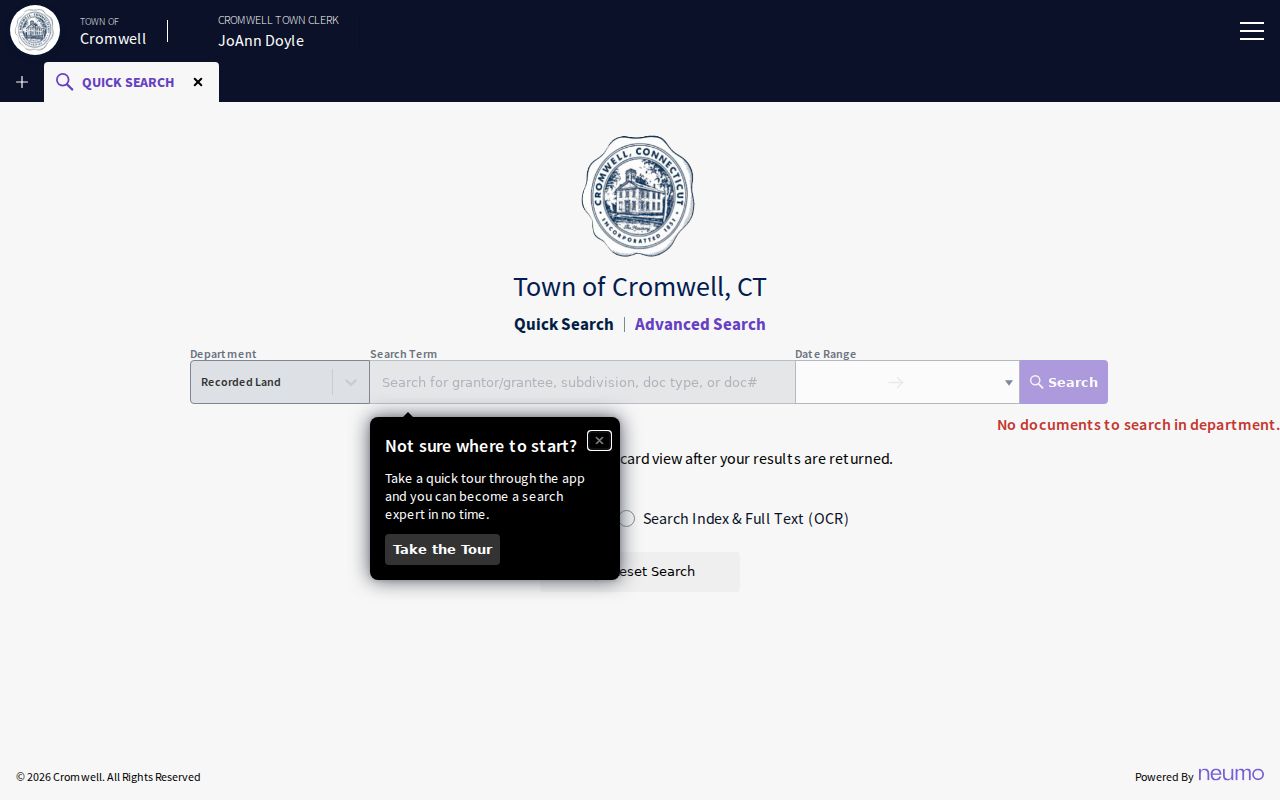
One name alone rarely pins down a deed. That is why the field set rewards queries pairing a party with a date range, a document type, or a recorded reference.
Follow Middlesex Grantor-Grantee Names
The grantor conveys the interest. The grantee receives it. Begin with the assessed owner on the grantee side to surface the likely acquisition deed, then test spelling variants like initials, trusts, estates, and entity punctuation, confirming the legal description before you settle on a match.
- Find the current assessed owner as grantee and open the newest plausible deed.
- Record its grantor, date, description, and prior book/page reference.
- Search that grantor as an earlier grantee and compare the same land.
- Repeat to the portal cutoff, then continue in books, microfilm, probate, or archives.
- Grantor
- The party conveying an interest.
- Grantee
- The party receiving an interest.
- Chain of title
- The linked sequence of recorded transfers for the same land.
- Book/page or instrument number
- The clerk's retrieval reference.
Middlesex Instruments Beyond Deeds
Clinton's recording system pairs a date-and-time stamp with a daybook entry and alphabetized grantor and grantee indexes. Digital scans sit alongside hard-cover vault books and Cott microfilm held at Iron Mountain. The vault reaches well past deeds. Holdings include affidavits, liens, foreclosures, powers of attorney, probate documents, maps, and variances, so search under both parties plus the parcel description.
A release can close out a mortgage while leaving its history intact. A lis pendens signals litigation. Pair that notice with the Judicial Branch docket for the fuller story, but remember the deed itself remains the instrument that transfers title.
Book and page or instrument numbers are retrieval keys. They are not parcel numbers. Copy them exactly when ordering a copy. Legal descriptions may lean on lot names, recorded map references, monuments, bearings, or metes and bounds rather than a modern street address, and when two deeds name the same owner yet describe different land, compare the prior-deed citation and the plat instead of joining them by name alone.
Probate can break a clean sale-to-sale chain. An executor deed may trail an estate file. A committee deed may follow foreclosure proceedings. Pull the probate or civil docket for context, then come back to the recorded conveyance itself, because a docket entry never substitutes for the deed.
Older Middlesex Deed Books
Russell Library's Local History Room holds Middletown deed material from 1654 through 1907. It also holds an early grantor-grantee index and supporting directories, maps, newspapers, and census microfilm. Those tools can identify an old street or occupant. A directory is still not title proof.
That span reaches back centuries before Middletown's 1969 portal cutoff. Clinton's older records live in clerk books and microfilm. Cromwell's online starting point matches its 1851 separation from Middletown. So older tracts may need parent-town context. When a description reaches that threshold, ask the current clerk where to look next.
Cromwell Property Fraud Alert
Cromwell's legacy records portal connects to a free Property Fraud Alert service. Anyone can enroll a name. When a participating office indexes that name, the subscriber gets a notice. The service cannot stop a filing. And a notice never proves a document is valid. The Property Fraud Alert source appears below.
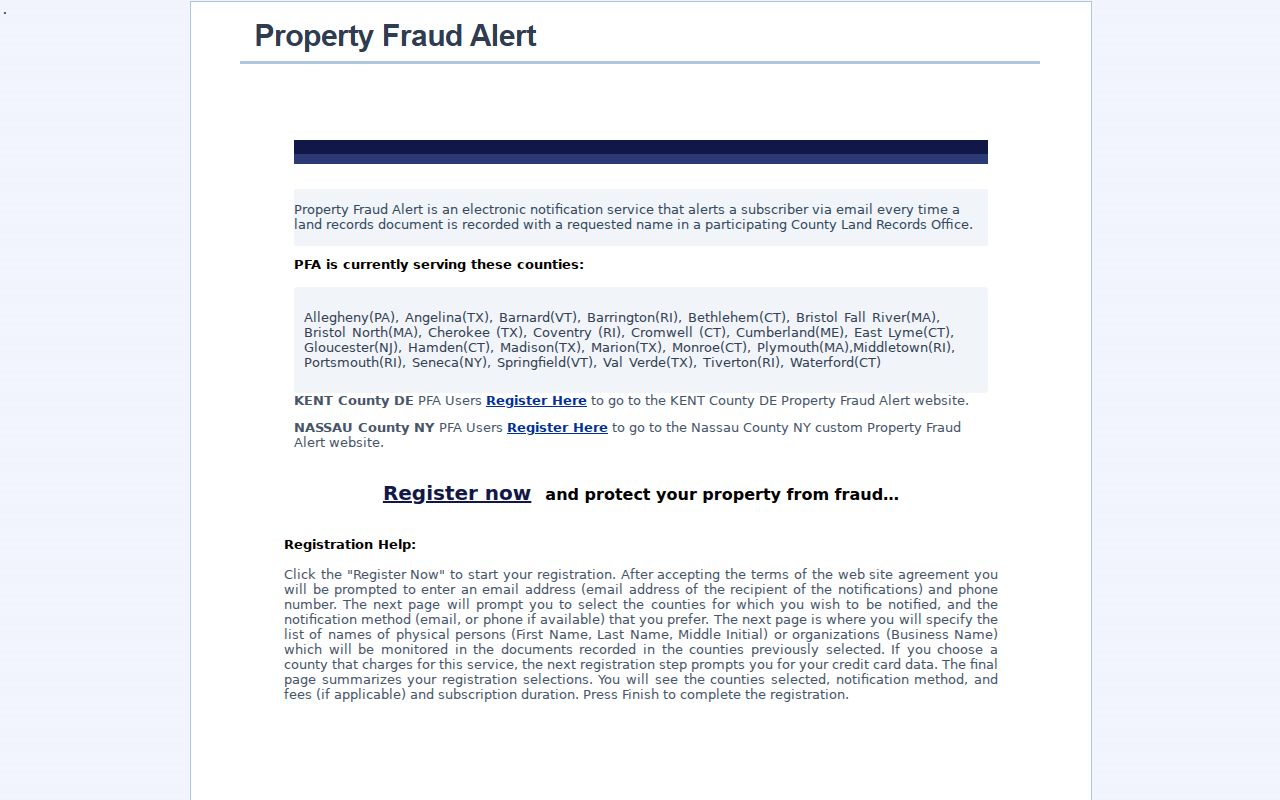
Treat any alert as a reason to check with the Cromwell Town Clerk, not as a title guarantee.
Middlesex Deed Access Channels
A full deed-record route in Middlesex County runs through web, counter, phone, mail channels. Library and archive channels round it out. Start with the portal's name index for indexing and any available image. Call the correct town clerk when the date predates online coverage. Also call when the interface exposes no stable document. Supply the grantor or grantee and an estimated recording date. Add the document type and any known book/page or instrument number. Ask whether the copy is plain or certified. Confirm the current fee before ordering.
At the counter, review the grantor and grantee indexes. Also review the daybooks, maps, and deed volumes available for that town. Clinton retains hard-cover vault books and older microfilm. Cromwell staff guide searches but will not perform them. Middletown's older path can include clerk books and Russell Library microfilm. The Connecticut State Library and probate records may explain estate or early court transfers. Certified deeds remain with the municipal clerk.
Connecticut FOIA provides a fallback for public administrative material. It cannot turn every deed image into a free certified copy. Nor can it erase a town's statutory recording rules. Frame a request precisely. Broad countywide wording fails because no county recorder exists to receive it.
Get a Middlesex Deed Copy
An online image works when the town and date fall within portal coverage. Middletown permits guest searching. Images and printing follow paid access. Cromwell's legacy service allows free search and watermarked viewing. Downloads and prints cost $2 per page. Result printing runs $1.50 per page. Verify current rates before purchase.
The town-clerk counter supplies the fallback. Cromwell lists copies at $1 per page. Certification there is $1 per page plus $2. Clinton lists $1-per-page copies and $2 certification. Request by town, party, date, type, and book/page or instrument number. The office can provide older books and certified copies. Staff may not conduct the full search.
Recorded, not guaranteed. Middlesex County deed records show filed instruments, not a title opinion. Unrecorded interests and unresolved defects may exist.