
Trace Middlesex County Former Owners by Era
Where you begin depends on the town. It also depends on the era of the transfer. Middlesex County has no county recorder of deeds. Each of its 15 town clerks holds the local land records. Those records cover that municipality alone. Digital reach varies sharply from one clerk to the next. Clerk vaults carry the trail into earlier periods. So do local map collections.
| Source | Years It Covers | Where Held | What It Shows |
|---|---|---|---|
| Middletown RecordHub | January 1, 1969 to present | Middletown Town Clerk and RecordHub | Indexed instruments and available deed images |
| Clinton RecordHub | Book 106 / 1976 to present | Clinton Town Clerk | Grantor and grantee entries, deeds, and related instruments |
| Cromwell land indexes | July 16, 1851 to present | GovOS and legacy US Land Records | Recorded-land index and images; maps from May 12, 1881 |
| Older books and local collections | Varies by town and collection | Town clerk vault, library, or State Library | Earlier deeds, plats, directories, probate clues, and historic address evidence |
Start online when the transfer falls inside a portal's date span. If it predates that span, carry the last sound book-and-page reference to the clerk counter. Never assume the first online entry marks a parcel's first owner.
Start a Middlesex County Previous-Owner Chain at the Newest Deed
Treat the municipal assessor card as a lead only. Confirm the current owner of record in the proper town clerk's deed index. For the newest deed, record the grantee, grantor, recording date, and deed type. Add the book and page or instrument number. Include the full legal description. Those fields anchor the first row of a backward chain.
| Transfer date | Grantor to grantee | Deed type | Book/page |
|---|---|---|---|
| Newest recorded transfer | Prior owner to current grantee | Read the indexed instrument | Copy exactly |
| Earlier transfer | Earlier grantor to the prior owner | Check the deed label | Follow the cited reference |
| Pre-portal transfer | Name sequence from the reverse index | Read the book itself | Request the volume and page |
The dates and names in a sample chain are labels, not Middlesex County facts. Fill every row from the official index. Use the deed image for the parcel being researched.
Preserve what each record actually says. Recording date and deed date can differ. A deed label alone may not disclose the whole transaction. Copy spelling, fiduciary terms, and entity suffixes exactly as indexed. Then compare the legal description against the parcel under study. A familiar surname is not enough, because several residents shared a name or held other land in the same town.
Middlesex County Ownership Depth Changes at Every Town Line
Middletown, Clinton, and Cromwell show why one countywide cutoff would mislead. Middletown advertises deed records from 1969. Clinton reaches Book 106 in 1976, and Cromwell's legacy system begins in 1851. The other towns rely on different portals and date spans, so locate the municipal custodian before concluding that an older deed is unavailable.
Online cutoff. The first digital entry is only a portal limit; earlier former owners may remain in paper books, microfilm, maps, or archives.
Searching a guest index is often free, while images, printing, or downloads may require payment. For a certified copy, ask the town clerk about counter inspection. The same applies to a volume outside the online span. Ask about the current copy schedule too.
Clinton's workflow adds useful detail. The clerk stamps each instrument with a receipt date and time. The instrument is then entered in the daybook. Names are indexed in separate grantor and grantee paths. Scans sit beside the hard-cover vault books, and older Cott microfilm is stored off-site. That structure explains why an index entry, a scanned image, and a physical volume are three access layers. They are not three separate ownership sources, but one deed reached three ways.
Reconstruct Middlesex County Prior Owners in Reverse
A deed chain runs backward by changing each name's role. The seller on the newest deed becomes the buyer you hunt in the preceding deed. Keep the legal description and parcel clues beside the name at every turn, and the former owners stay tied to the right land.
- Find the newest purchase deed by searching the current owner as grantee.
- Read the grantor, exact legal description, and any cited prior deed.
- Search that grantor as a grantee, checking initials, punctuation, trust terms, and entity spellings.
- Repeat while reconciling lot, tract, metes-and-bounds, book, and page references.
- At the digital cutoff, continue in the clerk's reverse index, deed books, or microfilm.
- Grantor / grantee
- The party conveying an interest and the party receiving it.
- Chain of title
- The ordered sequence of instruments affecting ownership of the same land.
- Reverse index
- An index used to find when a named person acquired property as grantee.
- Warranty / quitclaim deed
- Different forms of conveyance whose legal effect must be read from the instrument, not assumed from the index label.
Keep Middlesex County Former Owners Tied to the Land
Street addresses work as modern search keys. But old deeds often describe land by bounds, a named tract, a subdivision lot, or adjoining owners. A changed number or village name can make the same parcel look unrelated. Match the legal description and the map reference. Check the parcel key, acreage, and prior-deed citation too. This must all line up before adding anyone to the chain.
A recorded plat can expose a parent tract that was later split. Clinton holds about 3,500 maps indexed by map title and street. Cromwell's online map coverage begins in 1881. These plat and map records explain a lot. They show why one former owner conveyed a larger tract than the current parcel.
Probate and Court Files Can Bridge a Middlesex County Ownership Gap
Not every ownership change looks like a sale. An executor or administrator deed may explain why the name sequence breaks. So may an estate distribution, partition, foreclosure, or quiet-title judgment. Search the deed index for probate documents and fiduciary terms. Then use the proper probate district or the Middlesex Judicial District docket when the recorded instrument points there.
The Middletown Probate District covers Cromwell, Durham, Middlefield, and Middletown. Other county towns sit in different probate districts. Jurisdiction follows the town and the estate facts. Court web results also carry retention limits. The courthouse clerk is the fallback for older public files.
Liens and releases may cluster around the same names. Do not insert them as owner transfers. A deed or judgment must actually convey an interest. A mortgage records security, and a release closes that encumbrance. A lis pendens points to litigation. Keep those instruments in a parallel notes column. They add context without distorting the sequence of former owners.
Russell Library Adds Occupancy Clues to Middletown Past Owners
A deed proves a transfer happened. A city directory proves someone was receiving mail at an address. Between those two events, occupancy questions arise, and Russell Library's Local History Room answers many of them for Middletown. Its shelves hold city directories spanning 1871 through 1990, with some gaps, alongside newspaper indexes, microfilm of newspapers and censuses, atlases, architectural surveys, and older Middletown deeds.
Treat a directory listing as supporting evidence rather than ownership proof. A resident listed at an address may never have held title, and a titled owner may have gotten mail somewhere else entirely. The stronger method is comparison. Line up directory names against the deed sequence and the assessor record before drawing any conclusion about who actually held the parcel.
Check the Russell Library Local History collection before visiting in person. The blend of directories, maps, and deed material earns its keep when a changed street number breaks a straightforward name search.
Cromwell's Two Portals Preserve Different Research Paths
Cromwell keeps two doors open. The town currently links a GovOS Recorded Land search, while its legacy US Land Records site still carries the verified depth back to 1851. GovOS handles a search term, a date pair, quick date ranges, and a choice between index-only results or index-plus-OCR text. The legacy system is different.
Searching there is free, and viewing carries a watermark, with fees applying only to printing or downloads. That split is an insider clue. A sparse result on the newer portal should never end the investigation, because the older system may hold what the newer one lacks.
Work both official routes. Note each system's certification and coverage statement. Carry any unresolved reference to the Cromwell Town Clerk. Portal migration changes how you reach the records, not the legal sequence preserved in the land books themselves. The legacy Cromwell recorded-land index shows the historical access route behind the deepest verified digital span in Middlesex County. Its landing screen names the system and its coverage, though an actual former-owner chain still demands parcel-specific results.
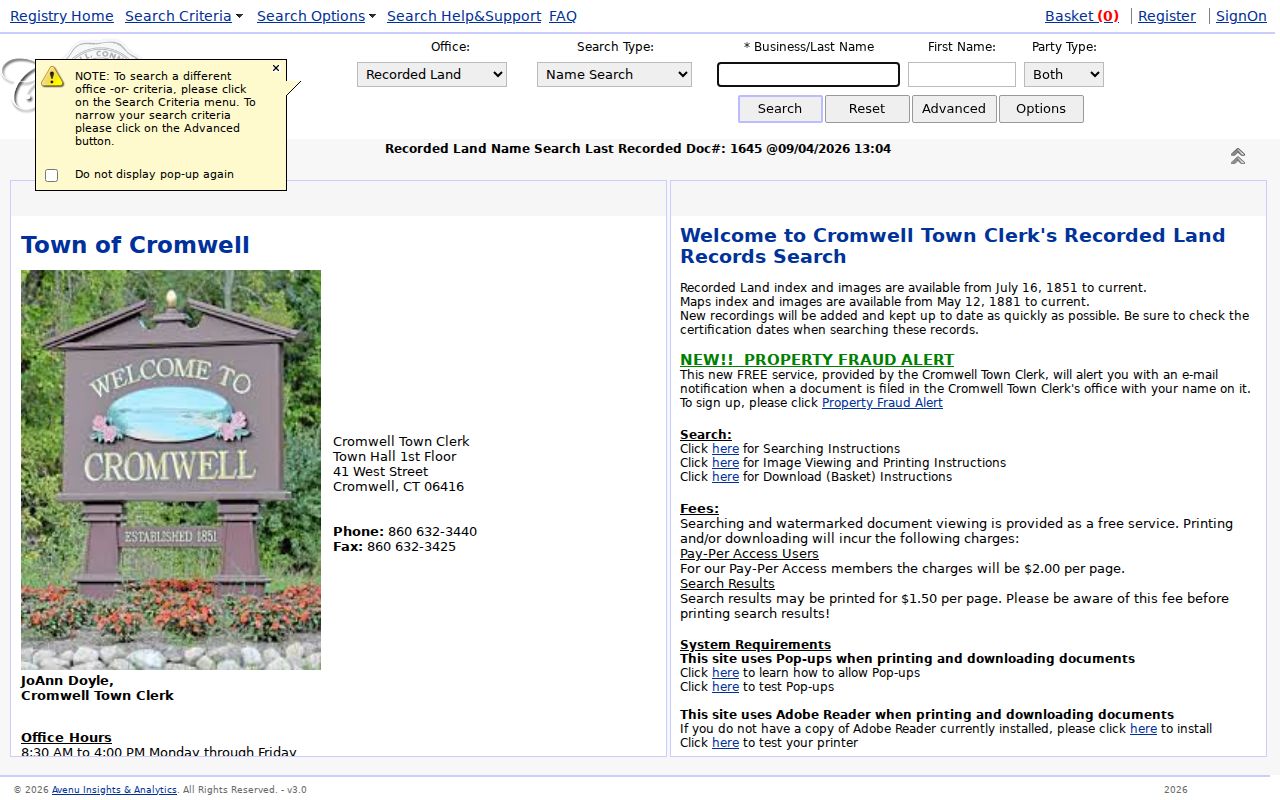
The image simply identifies the correct historical portal. It shows no selected deed and no prior owner's name.
Know Where Middlesex County Previous-Owner Research Must Continue
Online access is one thing. Record survival is another. Chain work on older Middlesex County properties often leaves the municipal portal behind and moves into clerk vault books, microfilm, recorded maps, local libraries, State Library archives, and probate holdings. Russell Library covers old Middletown deeds and long directory runs, while the Connecticut State Library opens genealogy, probate, archive, census, and digital-collection gateways.
Connecticut abolished county government in 1960. That change never centralized deeds under Middlesex County, so the town remains the key unit for both modern and historic land-record research. When a source shows a gap, state the gap plainly. Preserve the last verified legal description, then resume with the next custodian. Filling the break by inference is how broken chains stay broken.
Lawful use. Research previous owners for house history, estate work, or property diligence. Never use names or addresses to track, threaten, or harass anyone.